
La Bola Negra
Left Me Completely Undone
Writer: Anya Duncan

I am not an emotional film watcher. There have been films that have moved me, certainly, but it is incredibly rare that a film brings me to the state of emotion I felt during La Bola Negra. By the end, I felt completely consumed by it by the speed with which I had devoured every aspect of this project, and by the strange, aching feeling it left behind. It is gorgeous, devastating and so deeply tender that I suspect I will be thinking about it for a very, very, very, very long time.
La Bola Negra moves between three stories, separated by decades but bound together by queer identity, fascism, violence, desire, inheritance and the complicated ways history refuses to stay buried. In 1932, Carlos (Milo Quifes), a young gay man in Granada, is rejected from an exclusive social club when the members cast the titular black balls against him. In 1937, during the Spanish Civil War, Sebastián (Álvaro Lafuente Calvo), a Nationalist soldier, finds an unexpected connection with Rafael (Miguel Bernardeau), a wounded Republican prisoner whom he is tasked with guarding. And in 2017, Alberto (Carlos González) begins to uncover the buried history of his own family. The three stories gradually reveal themselves as part of the same emotional inheritance, connected not only by blood and memory but by Federico García Lorca’s unfinished play La Bola Negra.
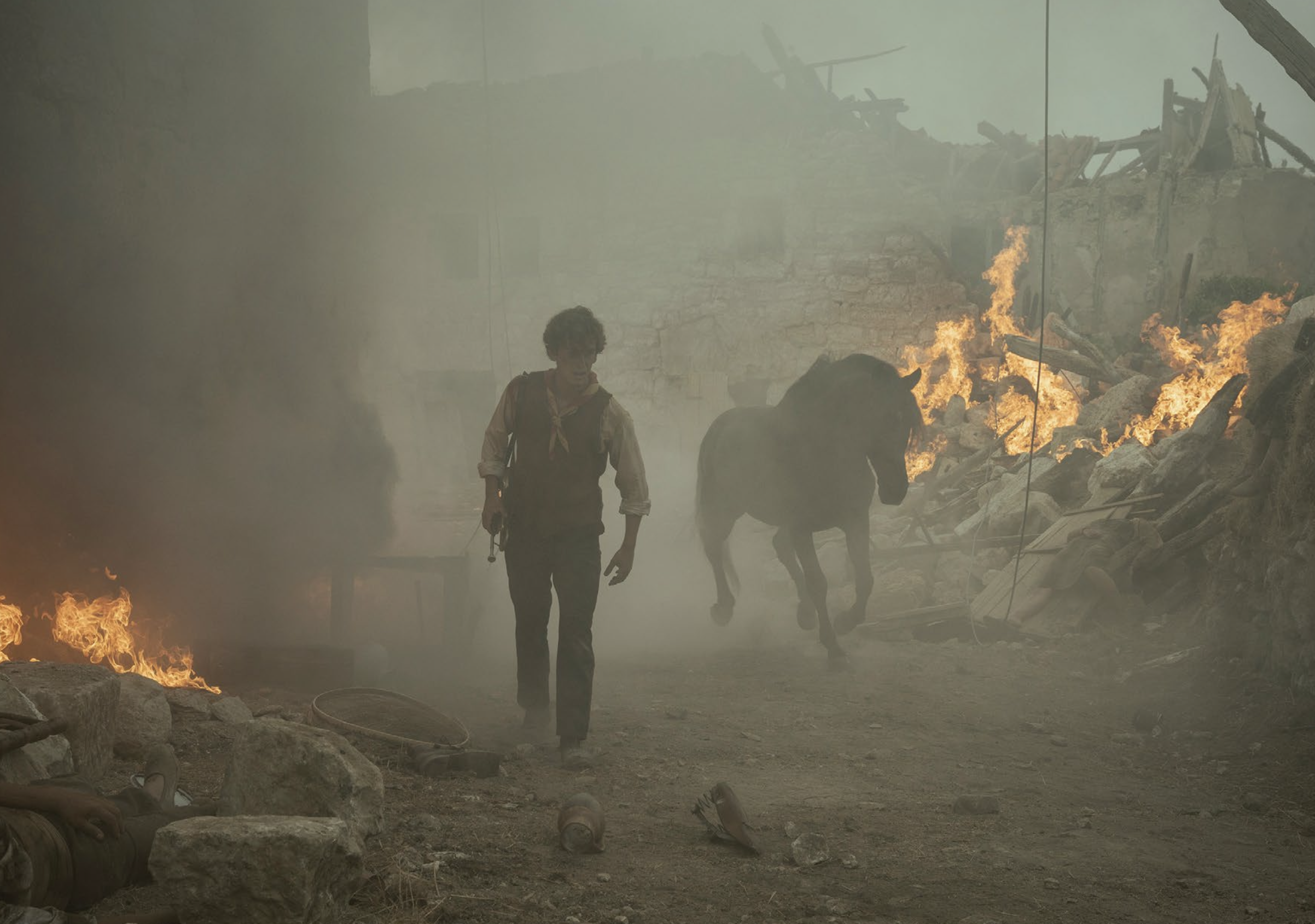
A beginning scene filled with marble rubble really sticks with me. The framing of these biblical remains of Sebastián’s childhood church was incredibly staged. So, too, was the camera as Sebastián desperately pulled himself over the stone to escape Italian soldiers hell-bent on killing him.
There is something about that rubble that feels like the film in miniature. Something once whole, now shattered. Something beautiful left in fragments, but still carrying the shape of what it once was.
There are layers to Sebastián a queer trumpet player turned Nationalist, later called fascist, who struggles to find a place and pick a side. He is a character caught in contradiction, and the film never tries to tidy that contradiction away. Instead, it sits inside it. Sebastián is political and intimate, violent and vulnerable, lost and desperately searching for somewhere to put himself. Almost everything he does feels frail and tender.
And then there is his counterpart, Rafael.
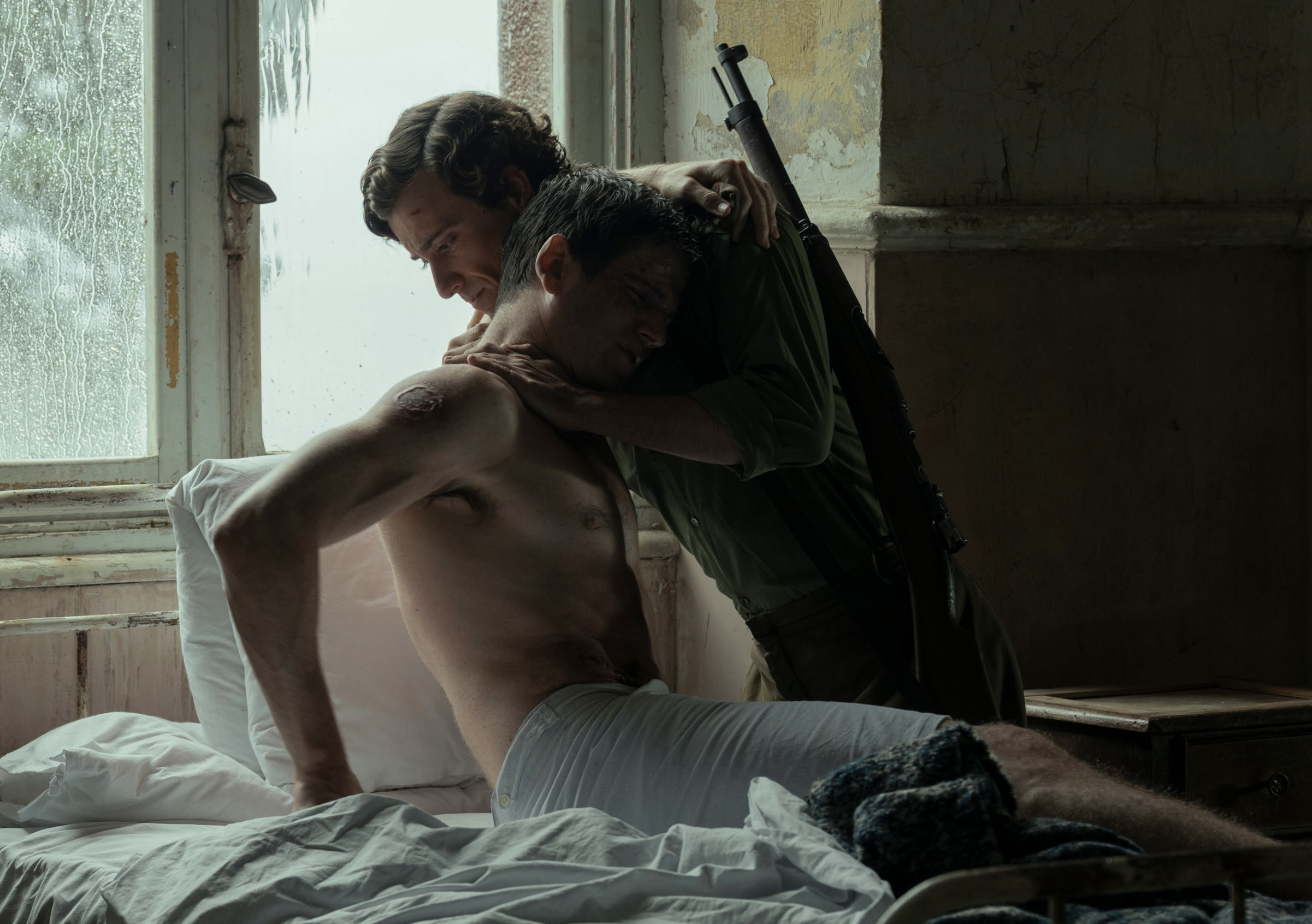
Watching Sebastián hover his hand over Rafael’s healing body was more tender than a thousand kissing scenes I have witnessed in my life. There is something almost unbearable about the restraint of it. The film understands that intimacy does not always need to announce itself. Sometimes a hand that does not quite touch says more than an entire romance, and in this queer context, that tragically understated form of adoration is both historically accurate and devastating to witness.
I was so moved by Sebastián and Rafael. Their relationship feels discovered rather than constructed two people finding one another in the depths of war, when everything around them is collapsing. There is something incredibly beautiful about the way the film allows their tenderness to exist alongside the ugliness of the world around them.
And La Bola Negra is a film that understands ugliness, too.
I love that it assumes its audience is intellectual enough to follow all three stories at once, without giving us clear boundaries between them. I remember feeling completely baffled when a beautiful shot of 1930s Carlos suddenly cut to a man scrolling through Grindr. But that shock quickly gave rise to humour. It shook me out of the mindset that everything about the film would be historic and tragic, which I really appreciated.
That moment says a lot about the film’s confidence. It does not want history to become some distant, sepia-toned tragedy. The past is not sealed away. It bleeds into the present. The desires, prejudices, fears and contradictions of one generation continue to echo through another.



Learning how the three main characters weave together was also fascinating. Every twist and turn felt natural. No exposition was awkwardly dropped into the story because the audience needs to know something. Instead, you learned each piece just moments before you needed it. The film trusts you to catch up.
Perhaps that is why its treatment of war felt so fresh to me. Directors have spent decades screaming at audiences about the effects of war, but La Bola Negra does something quieter and, somehow, more devastating. It allows war to exist around its characters rather than constantly pointing towards it. Perhaps part of my reaction comes from my own ignorance of Mussolini’s complete effect on Spain, but the film made history feel newly frightening precisely because it made it intimate and almost unimportant.
The film’s soundtrack, too, bleeds across generations. Sebastián’s trumpet haunts the narrative. It feels as though it is following these characters through time, appearing almost like a ghost. But what I loved most was watching the music build around the scenes. You can feel the score becoming part of the film’s skeleton, rather than simply accompanying what is happening on screen. It gives the whole thing an almost dreamlike quality, as though these lives are being remembered through sound as much as through image.
I can understand why La Bola Negra won Best Director at Cannes. It is expertly framed. Every shot feels intentional without ever feeling showy. There is an extraordinary confidence in the way the camera sits with these characters, allowing a gesture, a body, a piece of rubble or a glance to carry enormous emotional weight.
That is perhaps what I keep returning to: the film’s ability to make the smallest things feel enormous. A hand hovering over a body. Marble reduced to rubble.
A look between two people who know that the world around them has no place for what they feel.
These things accumulate until the film becomes emotionally overwhelming.
And that is what makes the film’s beauty feel so different from simple prettiness. La Bola Negra is beautiful because it understands that beauty can survive devastation. That tenderness can exist inside violence. That desire can survive repression. That a piece of music can carry a memory across generations. That something can be broken into rubble and still tell you what it once was.
The film is haunted by what people leave behind.
I expected to admire La Bola Negra. I did not expect it to break through whatever emotional barrier I usually have when watching films. I cannot remember the last time I felt so completely consumed by what I was watching.
There are films that make you think. There are films that make you cry. There are films that leave you impressed by the craft of the people who made them. And then there are films that seem to reach somewhere beneath all of that.
La Bola Negra did that to me.
It is an extraordinary film. Beautiful in almost every frame, intellectually confident without being condescending, and emotionally devastating without ever begging you to cry.
