
Halise Karakaya
alın yazısı - The art of creating a new world
Words By: Evie Summers
1st April 2026
Some of us look to books for our solace, some religious, some people. Halise Karakaya tells her audience to look on further. In her work we are called to the heavens to imagine a new world unbound by our physical confinement and encouraged to recognise the connectivity of our souls.
Istanbul, her home, her muse is the backdrop to Karakaya’s work and so it feels only correct to begin with our contextual understanding there. It is a city abundant, its culture, its food, its people – it isn’t then hard to understand how such a place can inspire such artistic wonder. While the Republic of Türkiye was founded on October 29, 1923 the city of Istanbul is approximately 2,600–2,700 years old. Karakaya’s work is a love letter to Istanbul and its time-honoured traditions and rituals. Its essence is sewn into the fabric of her being and soul of her work.
Starting her early career Halise studied at LaSalle College Istanbul, later moving on to Central Saint Martins, she set down the path of fashion design. We discussed how art played a part in her youth:
“I was always doing sketches, and art was quite a big part of my life, actually. But I studied fashion design. So, after that, I decided to go with the switch.”
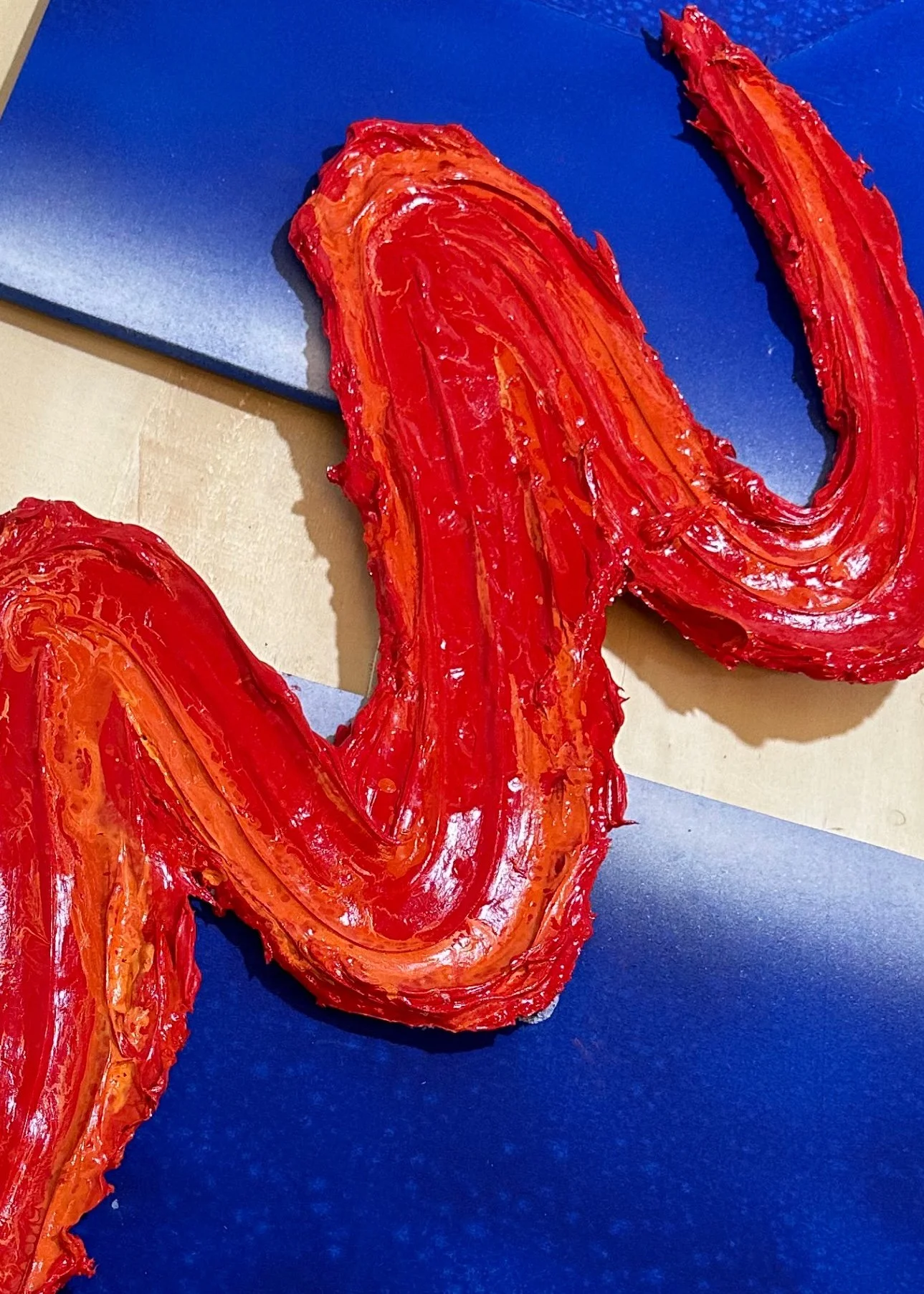
Her perspective is her gift and a skill she has found through a great deal of self-interigation and reflection. It's that reflectiveness that is the tenet on which her practise is built. Like many SWANA nations, Türkiye holds a deep and complex socio-religious history. This is in large part due to Türkiye's geographical situation; for centuries, and even beyond that, Türkiye could be understood as the bridge between Europe and Asia, and one of the few countries that span 2 continents. Osten described the bridge on the Silk Road, which has served as a trade and transit hub. Previously Constantinopolis, it was a vital place of exchange for not just goods but power, religion, and culture, used by two separate empires. This has, over time, developed a country that is inherently multicultural and rich. This understanding of Türkiye as a bridge extends beyond physical terms and is embedded in the country's soul, emblematic of a refusal to be either eastern or western and instead an acknowledgement of its own multifacetedness.
Over time this overlapping and intermingling of tradition has birthed a spiritual understanding of the world all of its own; taking elements from Sunni Islam, mystical Sufism, and pre-Islamic Central Asian Shamanic traditions. Though it can be characterised/comprehended through a deep reverence for ritual, destiny and personal ascension in aid of a deeply personal relationship to both god and the universe.
Karakaya's work offers us not only an insight into the essence of Istanbul but, importantly, a space in which we can explore our own thread in the tapestry of the universe. She avoided the ultimate sin of telling, not showing, by simply offering her creations as a vehicle for self-discovery “Of course, I prefer my work to ask questions rather than answer them. Most art becomes powerful when it's open space, where the viewers can reflect on their own emotions and experiences. Because it's an abstraction. It's actually a whole open world.”
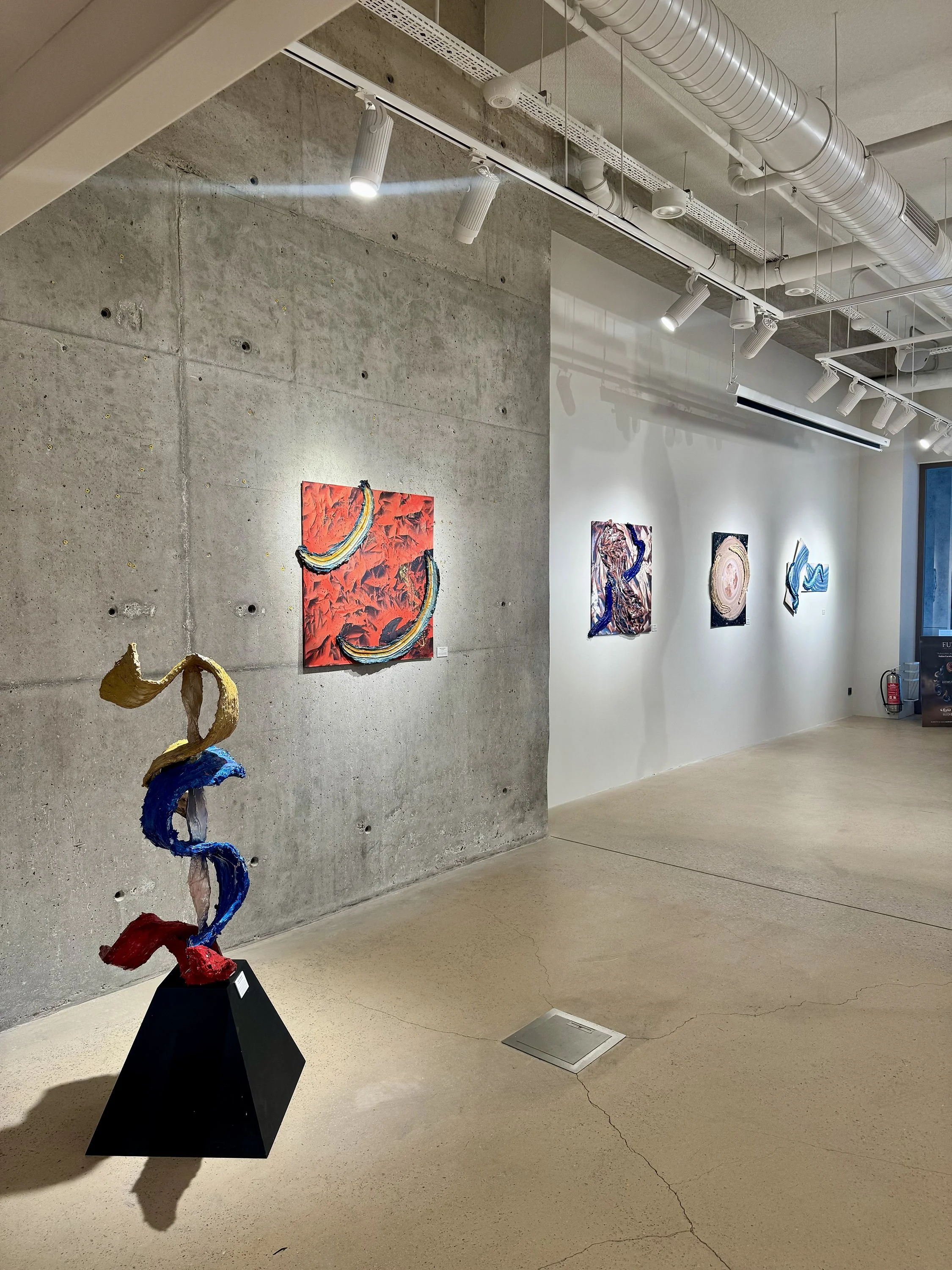
Her rationalisation of our place in the cosmos is conveyed through abstraction. Taking the concept from merely style to philosophy, her art questions in this vast world what connects our being beyond geography and physics. For her, it is our shared capacity for sensation. Our unity through emotional endurance is a fine, golden thread that holds us together.
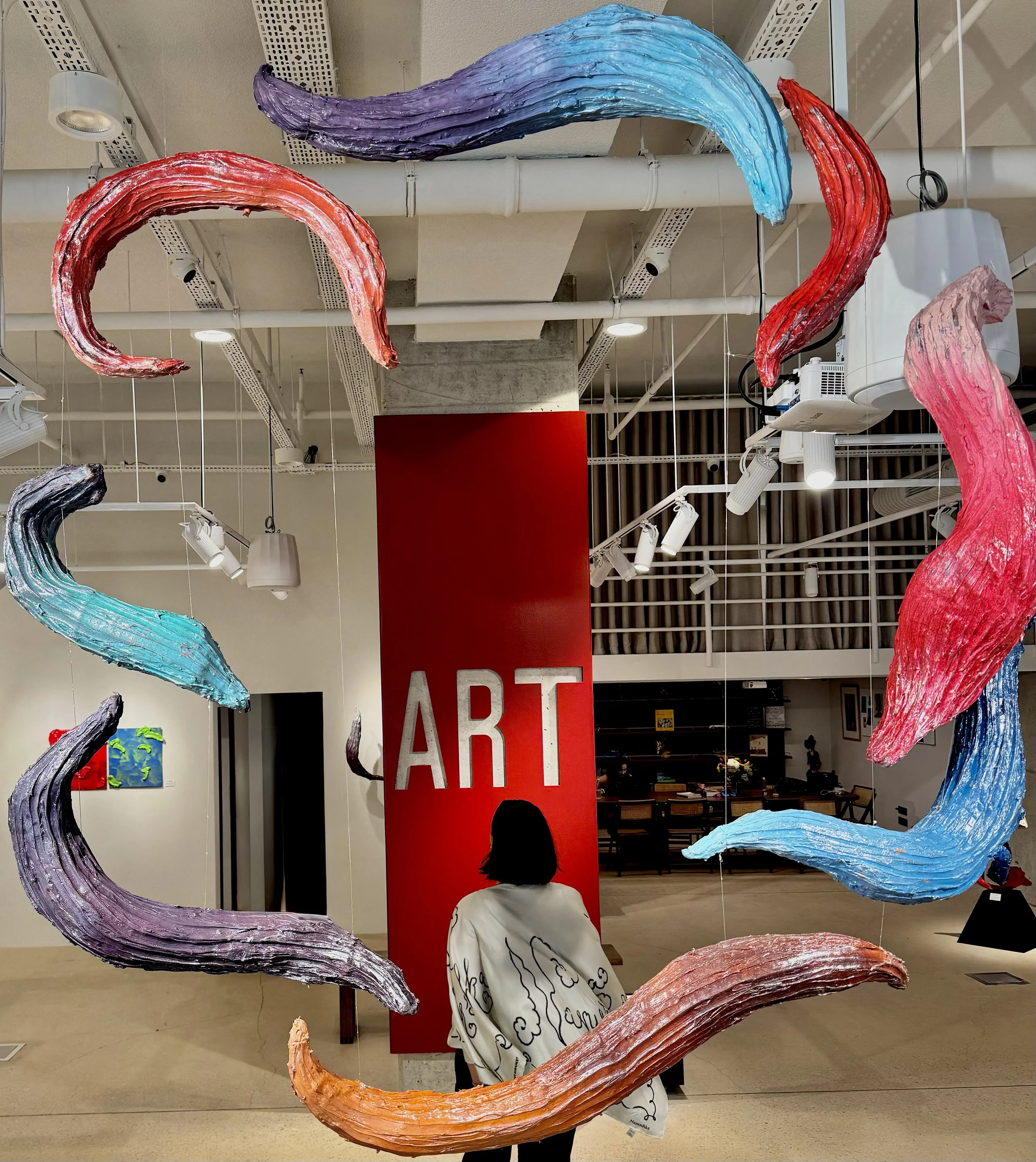
There is a lexicon in which this artist converses; it is one of sacred geometry and animate sculpture. There is a secrecy to the collections, a universe in which each exists and makes perfect sense. It is a fact that makes her work so beautifully interesting. Square canvas bathed in meseroisly bold background, each uniquely pulling, twisting or scrunching in new and intriguing ways. Wrapped with 3-dimensional brushed strokes that lick and curl around the scene, often branching out and extending in and off.
More than any other quality there is a vibrant animateness to each work regardless of the saturation of colour. Each piece feels like a moment captured and sustained. A dichotomy exists for me between the ephemeral vastness of what I am seeing and the decided sharpness by which the paintings are framed, made more intriguing by their stature. I get the feeling that what I am viewing is merely a small glimpse, a window into a great vastness one which I could lose myself within.
This is masterful, intentional, as I came to realise when I got the opportunity to speak with Halise, it isn't just about relating, it's about transporting the viewer to a new plane. She wants her audience to be living through new experiences with her work, “I want the experience to be totally new, because it's a different kind of experience, because you can feel it, you can hear it, like in my London Design Biennale installation. You can feel it. You can touch it. You can see and hear it. You can live in it. It's a totally new thing in abstraction.”
This commitment, this celebration of the senses, sets a great deal of her work apart. As stated previously, abstraction, for her, isn't simply a visual she picks up and puts down when convenient, but a philosophical lens that permeates her interaction with the world around her. It extends even to her approach to making. One element of her creations I found to be fascinating was her sculptural elements. Both materiality and form became points of considerable interest to me. I was taken by the material's uniqueness; my fancy was indulged when she informed me that the material she used was also her own creation.
As an aside, I am a person whose background is grounded quite heavily in sciences; this is where I have to admit I spend the majority of my life as a considerable nerd. Prior to leaving it all and choosing art, I spent my teenage years touring myself with triple science and computer science, further flagellating myself with chemistry and maths at a level. That being said, I am therefore impressed by the employment of practical making and edgenuity within art. There is something deeply impressive about someone choosing to create in a chemical material sense. I think it is part of what made me appreciate talking to such an artist so greatly, for me, she is constantly demonstrating a desire to make for herself and to truly create. It's a quality I think most in the arts find admirable, and one I often covet.
The forms were further rousing to my interest as I felt they appeared reminiscent of the styles of Turkish calligraphy I had seen previously. There was a smoothness, almost a finesse, in the raw brush shapes that, to me, mirrored the careful beauty of traditional calligraphy, the way they looped and swooshed. “Calligraphy is the most powerful thing in Türkiye. It's (her work) quite calligraphic, but I'm not trying to be like that because I'm just doing gestures. I'm inspired by them, but mostly by the emotions, colours, and movements.” In the way that calligraphy is now an inherent and deeply personal practice within Türkiye, so too is Halise's relationship to her sculpture.
Her shapes become an extension of her feeling and an illustration of the body's experience:
“I want to present emotions. We can feel the emotions through the body's movements. That's why most of the time I'm just thinking about the moments. When we are sad, how can we show it with our body language?”
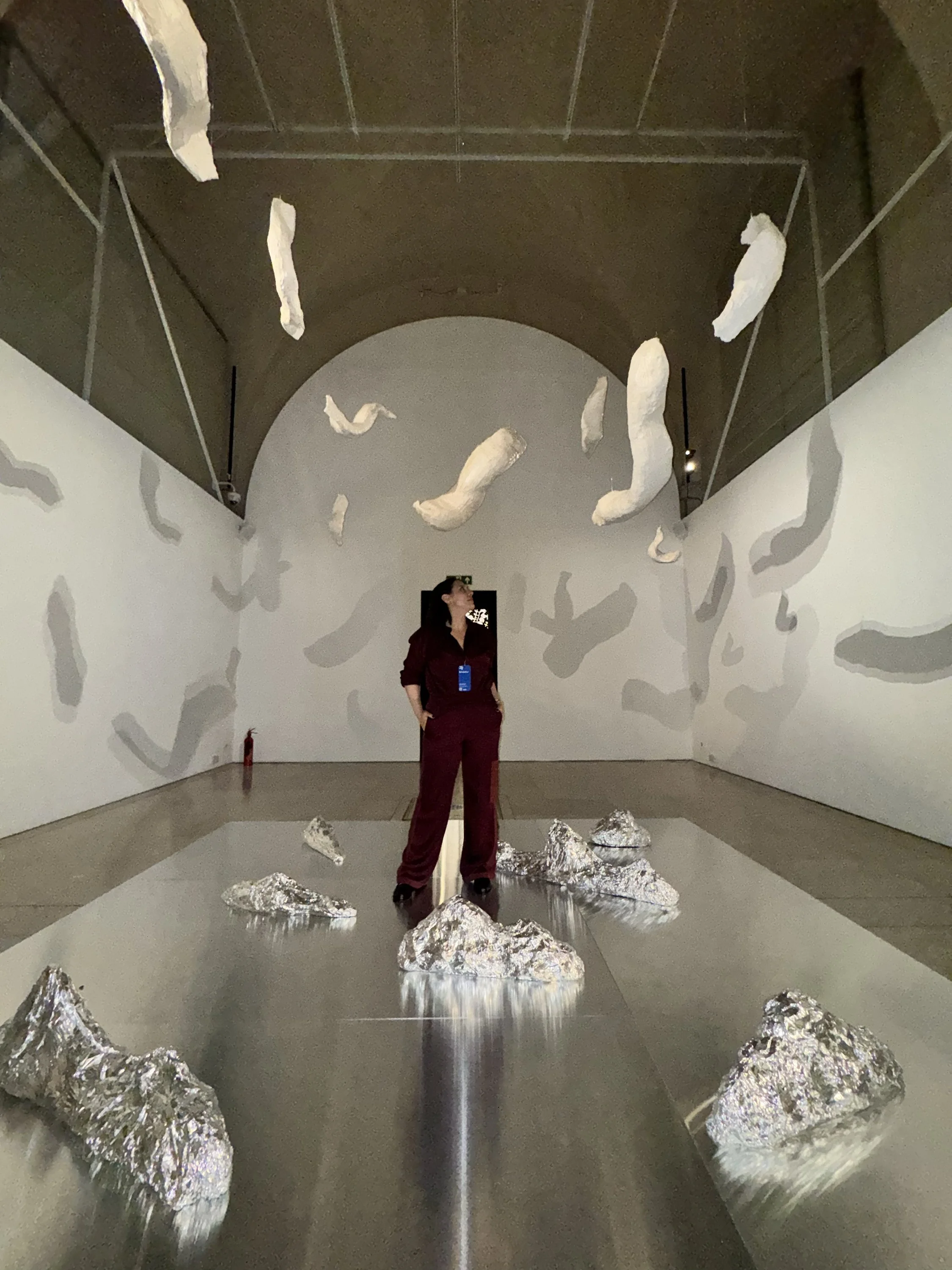
The connection from body to art, experience to understanding became perhaps more established in her piece “Emotional Reflections: The Soul of Seven Horizons” presented at London Biennale Design 2025. Where most of her pieces take the audience to this other realm of exploration, here, in this exhibition, where she represented Türkiye, she took us home.
The immersive installation paid homage in every way to her beloved city of Istanbul. Engaging the full human experience she draws us into a symphony of sights, scent and sound. Each element carefully crafted to transport the audience through a loving nostalgia that feels strangely universal to Istanbul. "I am inspired by Istanbul's seven hills and Istanbul's emotions. Istanbul has a sense of emotion and layers. It's a multicultural city, that's why I want to present those symbols with the Seven Hills and suspended Sculptures, all of them. And sounds, the Ferry horns, the Seagulls, waves with, all of it. I needed a mixture of Istanbul's feelings." Again the master not just telling the audience, instead she uses a minimalist aesthetic and instead captivates our most potent/effective senses.
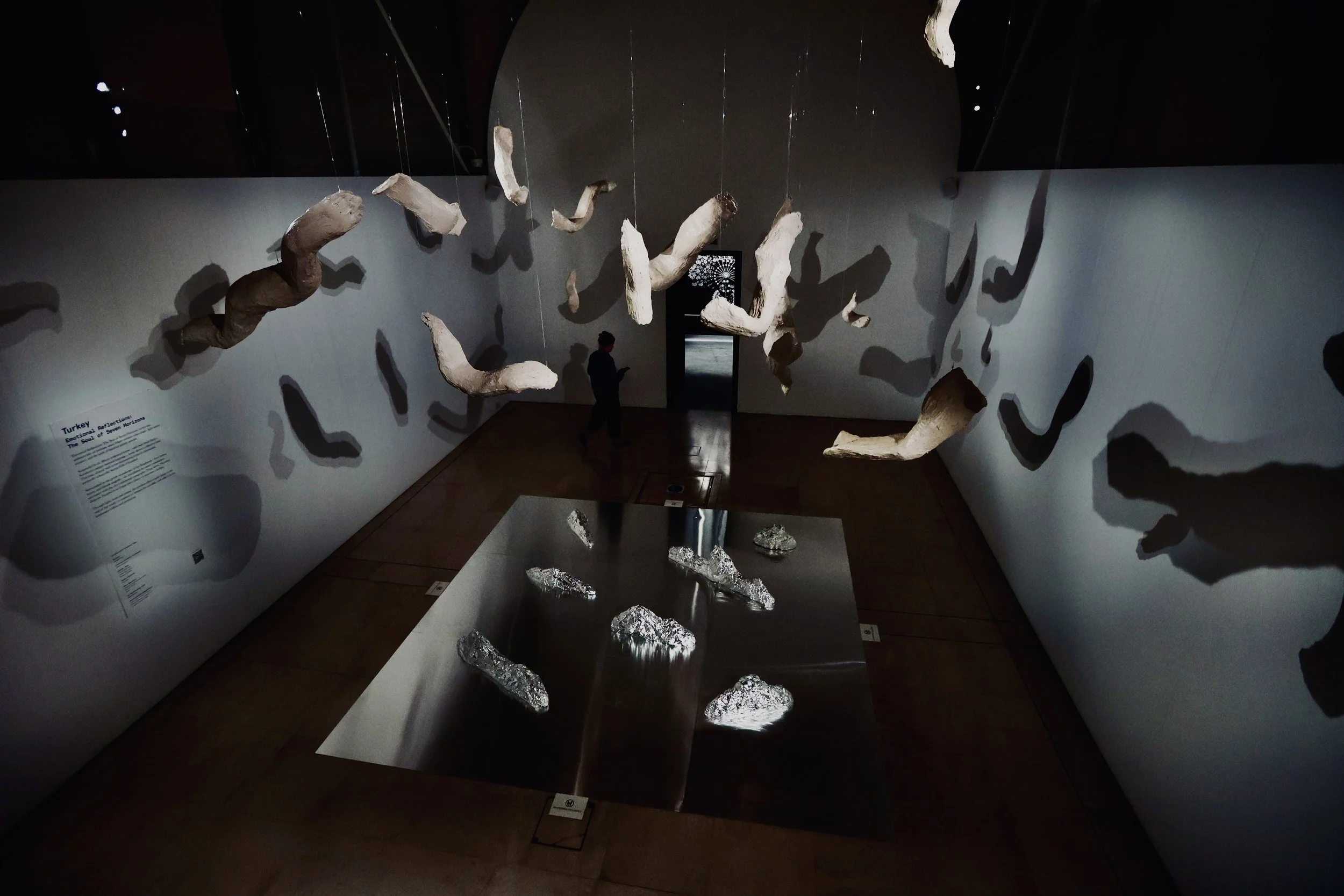
The success of the project is not to say it without its challenges. As is so often the case, time scales were short, elements had to be changed or excluded on the fly and Halise certainly left with some new unexpected knowledge. Originally the artist had planned to use ground coffee at the base of the sculptures, an aspect symbolic of the tradition and ritual of daily life in Istanbul. An idea that would have been wonderfully affective given the significance of coffee within Turkish spiritual practice such as fortune telling as well as its superior quality being a point of pride for many Turkish – including Halise. However, its inclusion was quickly shut down. As it turns out humans aren't the only creature that loves coffee. "They didn't let me use it because of the rats. Well, I learned something new. I didn't realise that rats loved the smell of coffee. We couldn't use it because it attracted them. In that period, I learnt new information."
I can’t say I blame the rats but surely a strange fact nonetheless.
Beyond this, further changes had to be made when it came to curation: “The number of suspended sculptures was partially intuitive but is also shaped by the building's constraints. Because the installation was presented at Somerset House, which is a historical place, we had to be mindful not to overload the structure or attach too many hanging points. For that reason, the final number was carefully balanced between the plan for the composition and the venue's structural limitations.”
What came through time and time again when speaking to Karakaya is this overwhelming care and thoughtfulness. As I planned this writing the word that seemed to appear so fervently in my mind was reverence. Through all of her creation and discussion there was the reverence for life, each element of her work at its core was about a love for places and people and a want to give space to connect with them. I strive to make work in my own practice that grants people the place to feel understood and to feel truly seen beyond shallow constraints, and as we spoke I felt a great kinship between our objectives. So often when I discuss people’s work I am impressed by what I see and in that I am incredibly fortunate, but to feel so reflected in your objectives is another wonder all of its own.
Halise is an artist who genuinely loves what she makes and that comes through and that I feel comes from a love of what she sees and moreover a want to share it through every sense and means. She is part of the coming wave of appreciation for SWANA talent that our art world needs desperately.
Whether it’s her perfumes, her art, or her offerings from Istanbul, keep appreciating and keep watching; it's times like these that call us to celebrate what is new.
