
All of a Sudden
A Three-Hour Thesis on Being Human
Writer: Anya Duncan
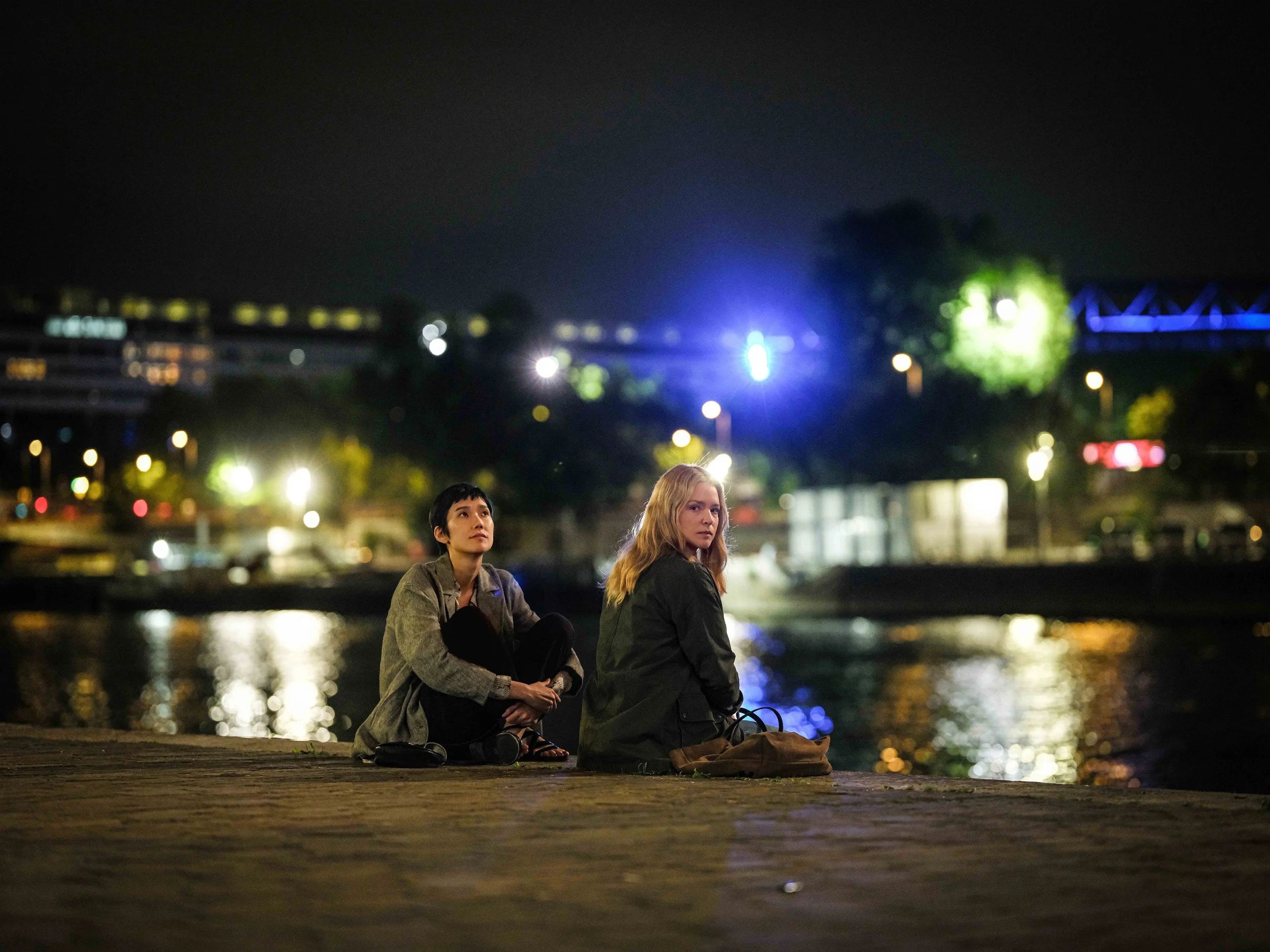
Ryusuke Hamaguchi’s All of a Sudden is the kind of film that seems determined to turn every conversation into a question about the nature of existence. It is over three hours long, and yes, you feel every minute of it. But this is not simply because it is slow. Hamaguchi has made something much more peculiar: a film so intellectually dense that it occasionally feels less like a drama and more like a dissertation that has wandered onto a cinema screen.
The film follows Marie-Lou (Virginie Efira), a French care-home director, and Mari (Tao Okamoto), a Japanese playwright, as their lives become increasingly intertwined between Paris and Kyoto. What begins as an encounter between two thoughtful women gradually expands into something much larger, as their conversations move towards questions of language, capitalism, care, displacement and what it means to exist outside the centre of society. As Mari becomes connected to the care home where Marie-Lou spends time, the film's intimate relationship drama slowly transforms into an examination of the systems that shape both women's lives.
There are moments of extraordinary beauty within this thesis on modern life. I loved the long amble the two central characters take from the theatre towards the River Seine. There was something incredibly reminiscent of Before Sunrise in this long scene, set just after Marie-Lou discovers Mari’s play. It is the sort of sequence in which Hamaguchi seems to understand that cinema can think without speaking. The walk allows both actors to breathe through heavy conversation with surprising dexterity and casualness bodies moving through space, conversation drifting, the city surrounding them and, for a little while, the film’s enormous machinery falls away. You simply watch people exist.
There lies my problem with this film. What makes All of a Sudden so frustrating is that Hamaguchi clearly knows how to create defined moments in the narrative, and when he does, they can be intoxicating. The film’s setting between Paris and Kyoto gives it an especially interesting geography: two cities that become intellectual poles connecting the two protagonists. Language, too, becomes a bridge and a barrier between the central characters. What can be said in one language cannot quite be carried intact into another. Both French Marie-Lou and Japanese Mari flip into their mother tongues each time they wish to better articulate their most honest feelings, while the other translates. Here I found both actors were electric, and I relaxed into the story being told.
Why, then, does Hamaguchi insist on convoluting these great moments with long sequences and ever-expanding monologues?
Both women spend the majority of the film trying to make space for the other coaxing the care-home director towards the poetry of Kyoto while the theatre director is enticed into the warmth of Parisian elderly care. This idea of the outsider is everywhere. And then, in the film’s second act, Hamaguchi decides to extrapolate this across our entire economic system.
The pair’s evening spent in Marie-Lou’s care home gradually transforms into something resembling a psychological and economic lecture, and it is a remarkably bold choice. Mari’s hypothesis about capitalism and its effects on our world order particularly her ideas surrounding the “Here/Now” and the outside is fascinating. There is something genuinely thrilling about watching a film allow itself to become this intellectual as Mari draws her vision of the world with whiteboard markers, but these are complex thoughts to be shared.
Mari asks the audience to stop pretending that the film’s characters are interested only in one another and instead ask what structures have produced them, what economic systems have shaped their lives, and what it means to exist outside the centre of those systems.
Perhaps these themes are too big to be stacked one after another for three-plus hours.
All of a Sudden sometimes feels as though it wants to contain an entire philosophy course within its running time. Every character arrives carrying a new proposition about the world. Every relationship becomes an opportunity to examine some larger social or psychological mechanism. Every silence seems pregnant with another theory. The film becomes an essay, then a dissertation, then almost a thesis defence. Eventually, you begin to crave the intellectual equivalent of a paragraph break.
That is ultimately where the film lost me. With something this long, you need moments in which the audience can breathe. You need the grand theory to recede occasionally so that a smaller human moment can take its place. Hamaguchi has created a vast ecosystem of lives and ideas, but he does not always distinguish between the moments that need to be witnessed and the moments that need to be explained.
The third act, when Mari moves into the care home, is where I found the film compelling again. There is something about this change of situation that gives the film a different texture. Suddenly, all those questions about isolation, dependency, capitalism, language and belonging acquire physical surroundings. The outsider is no longer simply an idea; she has somewhere to live.
And yet even here, the film struggles with its own abundance. There are simply too many characters vying for attention. I admired how carefully Hamaguchi fleshes out the ecosystem around his protagonists, and I admired the conviction with which he looks into seemingly peripheral lives. There is a generosity to that approach: nobody feels entirely incidental. Everyone appears to possess an inner world worth investigating.
But eventually that generosity becomes weight.
There is so much to cover that the film begins to feel less like a river than a reservoir, accumulating thought after thought until you can almost feel the intellectual pressure building behind the screen. I suspect this is a film that could take three or four viewings to fully digest. There are probably connections buried in it that I simply did not have the energy to excavate on a first encounter. And that is both its strength and its problem. I am intrigued by the prospect of discovering more in it, but I am not sure I have the appetite to watch the whole thing again.
Hamaguchi refuses to simplify his characters or his ideas for the sake of momentum. He wants to interrogate capitalism, displacement, language, intimacy, social hierarchy and the strange psychological geography of being an outsider. He wants to look at individual lives and then pull the camera back until those lives become evidence in an argument about the world.
The result is undeniably beautiful, undeniably intelligent and, at times, undeniably exhausting.
