
Godzilla Minus Zero
Is a Colossal Crowd-Pleaser
Writer: Anya Duncan
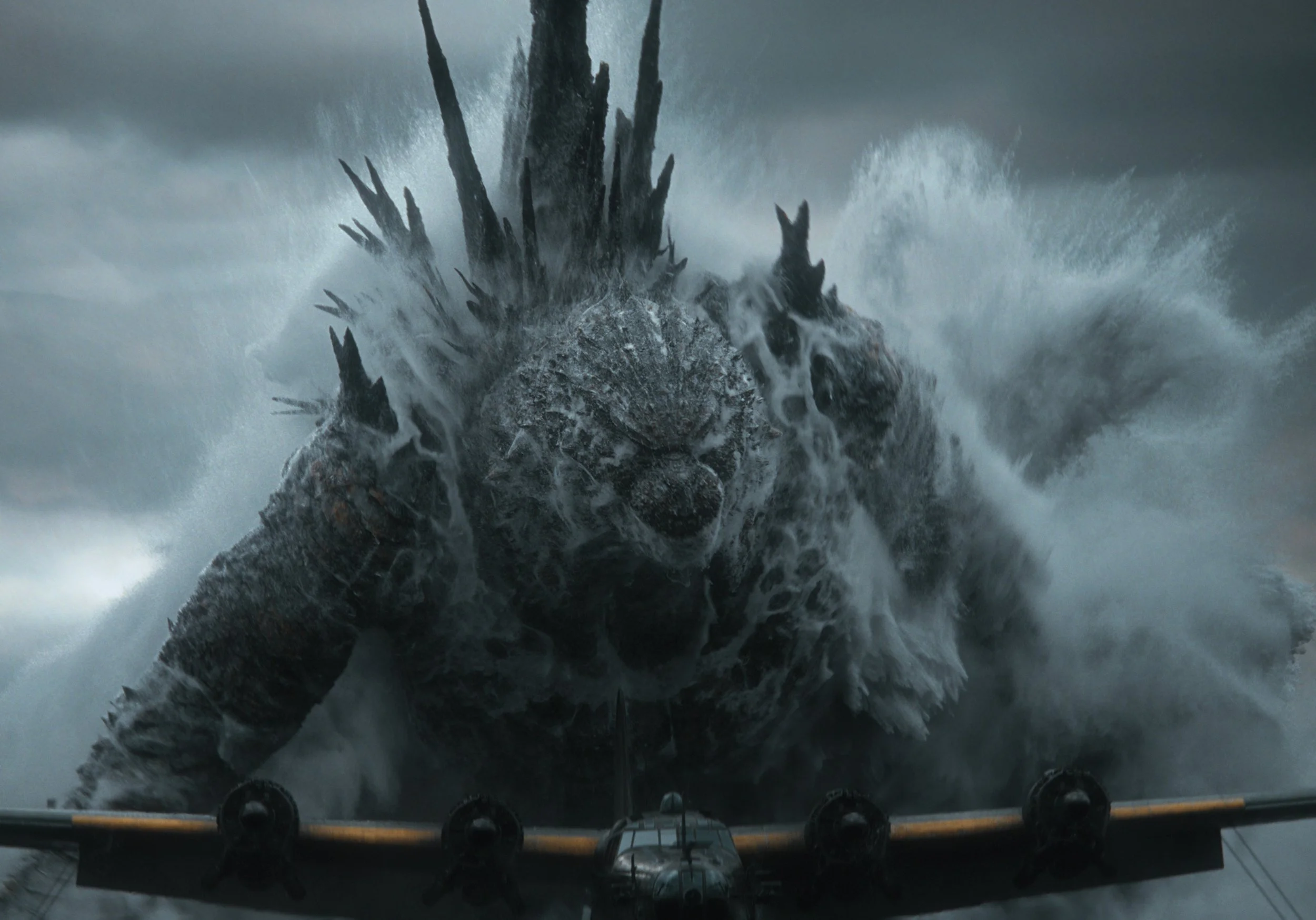
Godzilla Minus Zero understands the pleasure of spectacle. What makes Takashi Yamazaki’s latest instalment so effective is not simply the size of its monsters or the devastation they leave behind. It is the attention paid to the bodies beneath the destruction.
Set in 1949, two years after the events of Godzilla Minus One, the film follows former kamikaze pilot Kōichi Shikishima (Ryunosuke Kamiki) and Noriko Ōishi (Minami Hamabe) as they attempt to rebuild their lives and raise their adopted daughter, Akiko, in a Japan still struggling to recover from devastation. Just as the country begins to find its footing, Godzilla returns to threaten its hard-won peace. This time, the catastrophe is bigger still, with the arrival of another formidable monster: King Ghidorah. Once again, the Shikishima family finds itself caught between the possibility of a future and the terrifying prospect of losing everything.
At its heart, however, Godzilla Minus Zero is a film about family. Amid the enormous scale of its destruction, some of its most affecting moments belong to Kōichi, Noriko and Akiko. The relationship between the three gives the film an emotional centre that the spectacle can orbit around. The monsters might threaten to tear the world apart, but it is the thought of these people losing one another that gives the destruction its weight.
The performances are a significant part of this emotional foundation. Ryunosuke Kamiki brings a haunted quality to Kōichi, a man whose attempts to move beyond the past are complicated by the possibility of losing his future. Minami Hamabe does well to provide exactly enough emotion to carry a scene, while young Sae Nagatani, as Akiko, provides the film with something particularly precious.
Put simply, Akiko becomes a reminder of what all this destruction is supposed to protect.
The adults might spend their time calculating the odds of survival, but a child does not need to understand the mathematics of catastrophe to make its consequences heartbreaking.
And yet, for all its weight, Godzilla Minus Zero is actually quite funny.
There were several moments when a look or an action made me laugh, whether intentionally or otherwise. The American military sequences were particularly entertaining, with some of the supporting actors delivering expressions that seemed to communicate entire paragraphs of bewilderment without saying a word. Even in the face of a giant monster, people remain people: pompous, confused, frightened and occasionally ridiculous.
These moments of humour matter because they give the film room to breathe. A film cannot remain at maximum intensity indefinitely, just as a piece of music cannot sustain its loudest note from beginning to end. Yamazaki understands the value of contrast. He allows the absurdity of human behaviour to sit alongside the horror of the monsters, making the latter feel all the more overwhelming when they finally arrive.
And when they do, the film is magnificent.
The third-act battle is an extraordinary piece of filmmaking. Yamazaki pays close attention to the anatomy of Godzilla and Ghidorah, giving their movements a convincing physicality. Both monsters feel like enormous living organisms, each with its own weight, rhythm and capacity for violence.
It was satisfying to watching their scales settle as both monsters drew in a long breath, only to release absolute power upon each other. You feel the anticipation in their bodies before the destruction begins. The movements have a strange, almost animalistic grace, and the attention paid to their physicality makes the fight feel less like an animated spectacle than a genuine collision between two impossibly powerful creatures.
With cinema acoustics, these moments have real impact. The low frequencies seem to travel through your chest, giving every movement a physical consequence.
I also appreciated that the final battle did not last much longer than it needed to. Too many modern blockbusters seem to believe that a third act must become an uninterrupted mega-battle, with the volume and scale escalating until there is nothing left to escalate.
Godzilla Minus Zero largely avoids that trap. Its climactic confrontation is long enough to feel monumental without consuming the entire film. The restraint makes the action more effective, not less. When the battle finally arrives, it feels earned.
There is one shot in particular that I cannot stop thinking about. During the third act, the car Mr Noma is driving tips over. Once the vehicle flips, the camera becomes noticeably less polished, jolting as it moves towards him. It is a small departure from the film's otherwise controlled visual language, but that is precisely what makes it so effective. For a moment, the choreography gives way to something rawer. You feel the camera's movement as though the person operating it has been thrown into the same chaos as the character.
It is a rare glimpse of a less polished filmmaking style within a film that is otherwise so carefully composed. I loved it.
That said, there were moments when the illusion did falter. The CGI crows, in particular, were not especially convincing, and there was one brief instance when I found myself looking at the effects rather than inhabiting the world of the film. But to dwell on something so minor would be to ignore the extraordinary amount of work that makes the rest of it function. The overall visual achievement is impressive, and a few unconvincing birds hardly undo that.
Ultimately, Godzilla Minus Zero is going to go down very well with general audiences. It is a classic crowd-pleaser, delivering the kind of monster spectacle that makes a packed cinema feel like the ideal place to be. I would go as far as to say that it is the best Godzilla film we have. Yamazaki understands the appeal of these creatures and the comic origins it stemmed from, but he also understands that their power depends on the human scale against which we measure them.
Still, there is a qualification to that praise.
For all its technical accomplishment, emotional sincerity and spectacular action, Godzilla Minus Zero remains, at the end of the day, a Godzilla film. And when I compare it with some of the other films on show at the festival, I cannot help feeling that it is a little shallow.
This is not necessarily an indictment of what the film sets out to do. There is real skill in making a crowd-pleaser this effective, and there is genuine intelligence in the way Yamazaki balances family drama with monster mayhem. But the film's ideas rarely feel as adventurous as its visuals. Its emotional beats are effective, its characters sympathetic and its action extraordinary, yet I found myself wanting something more.
Perhaps that is an unfair expectation to place on a film whose central pleasure is watching two giant monsters tear into one another. Not every film needs to be intellectually overwhelming to be worthwhile.
While Godzilla Minus Zero does not always have the depth to match its scale. But when it works, it is a tremendous piece of cinema funny, moving, technically accomplished and absolutely thrilling to watch.
