
In Conversation with…
Interview By: Michael Morgan
Words By: Lily Egleton
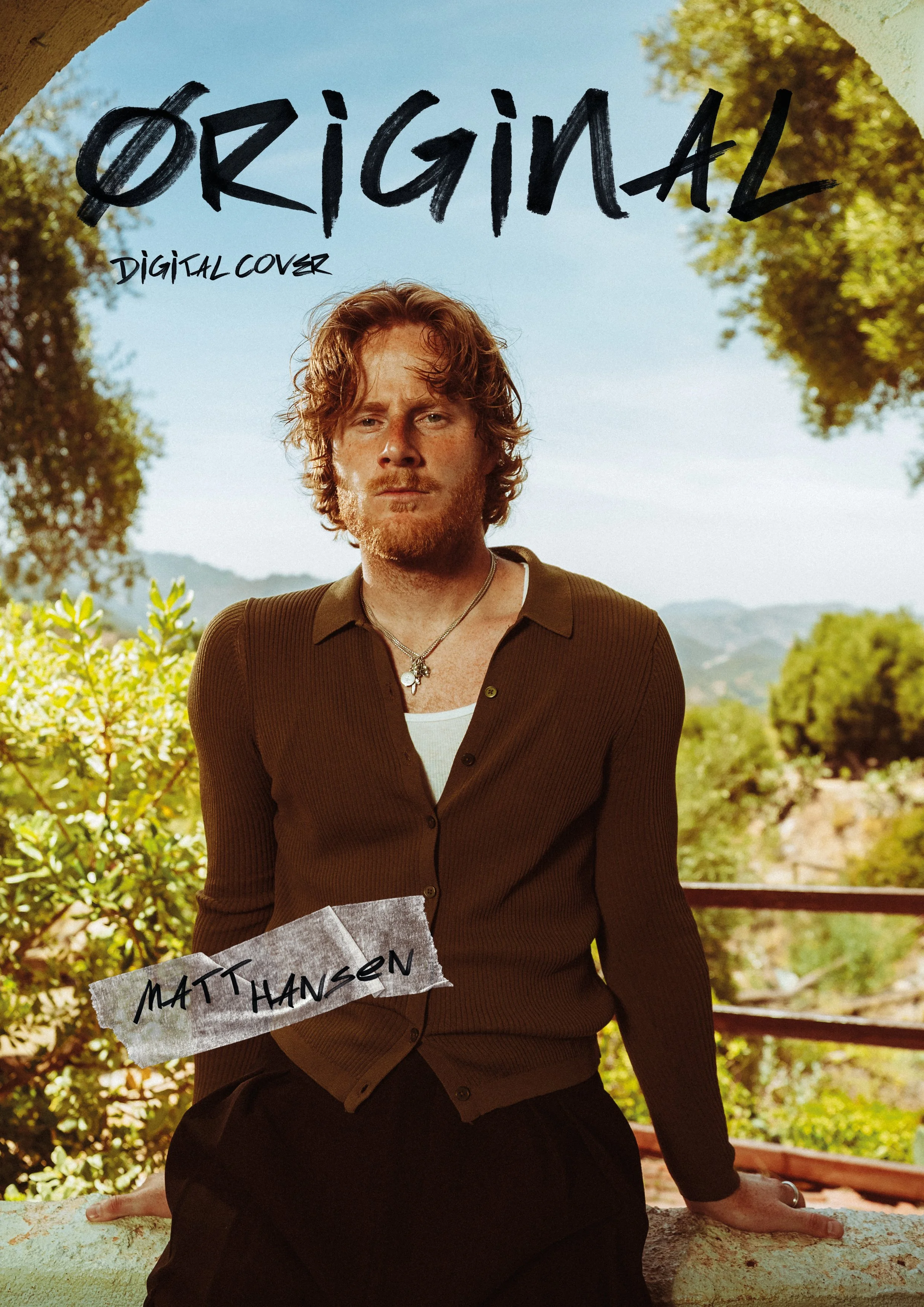
Matt Hansen’s upcoming tour begins in Dublin, Ireland, in early October and ends in California the birthplace of his music. He immersed himself in the music industry and musicology at the esteemed Herb Alpert School of Music at UCLA, and his music began to pique interest across his Instagram and TikTok channels. With his distinctive voice and emotionally resonant lyricism, Hansen has built an audience around music that strikes the listener as vulnerable, honest, and unapologetically human. Original Magazine caught up with Matt Hansen to discuss his journey as an artist; the stories and inspiration behind his songs, and what it truly means to place such a personal part of yourself into your lyricism and art.
For Hansen, virality was never the set goal. From a one-take Frank Ocean cover recorded during lockdown to Orchid an ambitious new chapter of music Hansen has built a career around emotion, honesty, and the belief that “the song is still king”. There is an interesting contradiction at the heart of Matt Hansen's career. He is an artist whose rise is almost impossible to separate from social media, yet his creative philosophy seems to be built around stepping away from it. His career accelerated through TikTok. His audience was built online. His songs have found enormous audiences through short-form videos. And yet, when Hansen describes where he actually writes, it isn't surrounded by screens, analytics or algorithms. It is the desert. It is forests. It is mountains. It is silence.
“I think I'm always a big fan of the silence and the quiet,” Hansen says. That juxtaposition feels crucial to understanding Hansen as an artist. His public career may have been accelerated by the feeling of instant gratification and immediacy of the internet, but Hansen’s art itself comes from somewhere much slower. His journey notably began during COVID, when Hansen's friends dared him to record himself singing Frank Ocean's Godspeed. He put his phone up, sang the song and uploaded the result.
“It started with me just putting my phone up and singing Godspeed by Frank Ocean,” Hansen reflects, “and it was actually started as a dare, my friends dared me to do it and i just did it. It was during COVID and I had nothing else to do.” There was no elaborate campaign, strategy, or budget behind it and neither the expectation that it would become a career-defining moment. Hansen didn't even record multiple takes: “That was a one take. I didn't do any other takes of that video.” That detail might seem insignificant, but in retrospect it suggests a great deal about what happened following this one take. The recording worked precisely because Hansen wasn't trying to make it work. He wasn't performing the idea of an artist going viral; he was simply singing.
For Hansen, that altered something fundamental in the way he understood his own voice. “I think I just realised that there was so much more that I connected to when I was just, you know, singing with emotion rather than trying to sing for perfection and trying to find, you know, specific notes”. It was a discovery that surpassed technique. Hansen had spent years concerned about whether his voice was technically good enough to make him an artist. Abruptly, the thing that made him distinctive wasn't necessarily perfection. It was emotion.
“When I was singing with emotion, there was this new thing that came out, which now I'm pretty known for, which is this raspiness and my register and I had never really done that before,” Hansen states. That rasp would become part of Hansen's sonic identity, but his description of discovering it is perhaps more revealing than the characteristic itself. He describes the moment as the beginning of singing “from my heart rather than my head” a feature of his music which now would feel incomplete without that degree of emotion and care.
The numbers that followed were extraordinary. Initially, Hansen thought 2,000 likes was an achievement worth celebrating. “I posted the video and in the first like five hours it got like 2 000 likes and I was just stoked. I was like 2,000 likes and I got like 200 followers i was like there's no way this is so cool,”then he went to sleep. By morning, the scale of what had happened had changed completely. “I woke up to like 200,000 new followers,”his reaction was disbelief. Hansen recalls everyone he knew, only to discover that they already knew. It’s a fascinating and by-chance occasion that in an industry where artists can spend months planning content designed to produce a viral moment, Hansen's breakthrough came from doing almost the opposite.
“It was the first time in my music life, because I've been I've been trying at music for so long it was the first time that I wasn't trying to go viral if that makes sense,” he states, and perhaps that is why his interpretation of the moment has remained less focused on the numbers than on what it taught him, “just make the stuff that you love enjoy what you make and whether it goes viral or not is totally not up to you it's up to the people. ” For aspiring musicians, that may be one of the most useful observations Hansen makes during the interview. Social media can generate the illusion that success is something that can be engineered: post at the right time, use the right sound, create the right hook, repeat what works. Hansen's experience indicates something less controllable: “If you make good enough stuff people will come and find it.” He describes the lesson he derived from this as “a great entry into you know into succeeding in the industry,” because it forced him to relinquish some control.
“It took me letting go of the reins just a little bit for it to actually happen,” he states. That idea of letting go appears repeatedly throughout Hansen's creative philosophy. The viral cover happened when he wasn't trying to make a viral cover. His songwriting improved when he stopped obsessing over technical perfection. One of his most successful songs, Let Him Go, was one he expected to fail: “I thought that Let Him Go would flop I was like I don't know it's fine and then, of course, it's my biggest song.”
There is one key concept that keeps returning throughout Hansen’s story: he can make the music, but he has no control over what people do with it. “You just really never know,” he states. That uncertainty now appears to be shaping the next stage of his career. Orchid represents one chapter of Hansen’s songwriting, while newer songs including Same Time Thinking About Me and Unspoken begin to point towards something different, and more hopeful. The transformation is partially one of reflection of Hansen’s own life who’s “been lucky to be very happy lately,” and that happiness has forced him to reconsider a songwriting style that has often been rooted in darker emotions. “A lot of my songs were based off of the state that I was in… at the time,” he explains. Continuing to write deeply depressing songs while feeling “a very generally happy person” began to feel “disingenuous.”
Rather than forcing himself back into an emotional state that no longer feels natural, Hansen wants his music to evolve with him. He states he “kind of wanted to move into this more hopeful direction,” though that doesn’t mean leaving sadness behind. “I'll never get away from the sad songs,” he says. They remain “one of my favourite things to make in the entire world.” The difference is that sadness no longer has to be the destination. Hansen says he wanted listeners to feel that “there was an end to that kind of feeling,” describing the journey he hopes his music can offer as one that moves “from pain to hope.” That feels like a fitting description of the transition between Orchid and whatever comes next: the heartbreak and melancholy are still there, but Hansen is increasingly interested in what happens afterwards. That evolution also means moving beyond the emotional extremes Hansen feels people may associate with him. “It was either like really sad or like really happy,” he says, admitting that he “didn't really want that to be my only thing.” Instead, he wants his music, and perhaps the audience’s understanding of him - to become less predictable. “I wanted them to be kind of ambiguous sometimes.”
Thinking About Me offers an ideal example of that shift. More playful than some of his earlier material, the song allows Hansen to explore a side of his influences he hasn’t fully embraced before, particularly the folk-rock and singer-songwriter world of artists like Tom Petty and Sam Fender. It is part of a broader expansion of creativity rather than a complete reinvention. Hansen is still emotional and introspective, but he is becoming increasingly experimenting with different sounds and allowing his music to exist somewhere between pop and folk-rock. That same insinuation of expansion appears in the visual world surrounding his music. Nature has long featured in Hansen’s videos, but it is not simply an aesthetic choice. “I've always posted videos… in nature or on some mountain or in some forest,” he states, because that is also where he writes and creates most of his music. There is something about those environments that helps him access the introspection at the heart of his songwriting.
In nature, “you feel so small and insignificant, but you also feel like your thoughts and everything… they're so present.” Being alone outdoors makes it easier to turn inward and develop that sense of introspection, and that feeling has become central to the world he wants to build around his music. Additionally, this could explain why Hansen’s visual and live work tends to feel cinematic. He desires his works to combine scale with vulnerability, describing the ideal experience as “extremely cinematic but also… very intimate.” This balance will be particularly important as Hansen takes Orchid on the road. Rather than simply performing the songs within a concert, his hope remains that audiences will understand the emotions and experiences behind them. “I love talking about the reason that I made a song before I play it,” he reflects, partly because, as a fan himself, he always wished artists would talk more openly about what they were feeling when they wrote their music.
For Hansen, those stories of inspiration can make the songs feel more personal: something he describes as “cathartic for me” as well as “cathartic for the audience.” The audience, after all, brings its own history to the music. Hansen knows that listeners may have a particular song that “helped them through something” or carries a deep emotional connection, and he wants the live show to leave room for those experiences. That makes the Orchid tour more deliberately narrative than his previous shows. “This tour in particular is the most… storytelling journey that I've ever tried to put on,” he states, with the album being played in full and the setlist designed to follow the emotional journey he created when sequencing the record.
Even the pacing of the show is carefully considered. Hansen is willing to change the setlist when something suddenly connects online - as we have witnessed occur when Someone To You went viral - but he doesn’t simply want to stack every crowd favourite together and force it to fit. The most essential thing, he says, is ensuring “the impacts are at the right places so that it doesn't feel like it's dragging.” For Hansen, a good setlist is another form of storytelling. Every song matters, but so does what comes before and after it. “Generally, we really think about the set list beforehand and make sure that it feels like it flows perfectly.”
Once his touring is over, Hansen plans to return to the environments where he feels most creatively focused. He enjoys “stepping away” for writing camps in isolated places such as Joshua Tree, where the quiet allows him to shut out everything else. That separation matters because Hansen admits he has “a pretty like one track mind.” Touring brings together shows, travel, promotion, social media and marketing, and trying to write alongside all of that leaves him feeling as though he is “shortchang[ing] one or the other.” So when he writes, he prefers to remove the distractions entirely and ask one simple question: “what is the best song that I can write?” He has already begunworking on his next project and believes it may come together faster because he has become “a lot more of an aware songwriter” about what he actually wants to say. He hopes to start releasing the new music at the beginning of 2027, and he certainly isn’t short of material. There are, he says, “like a thousand songs” sitting in an unreleased folder.
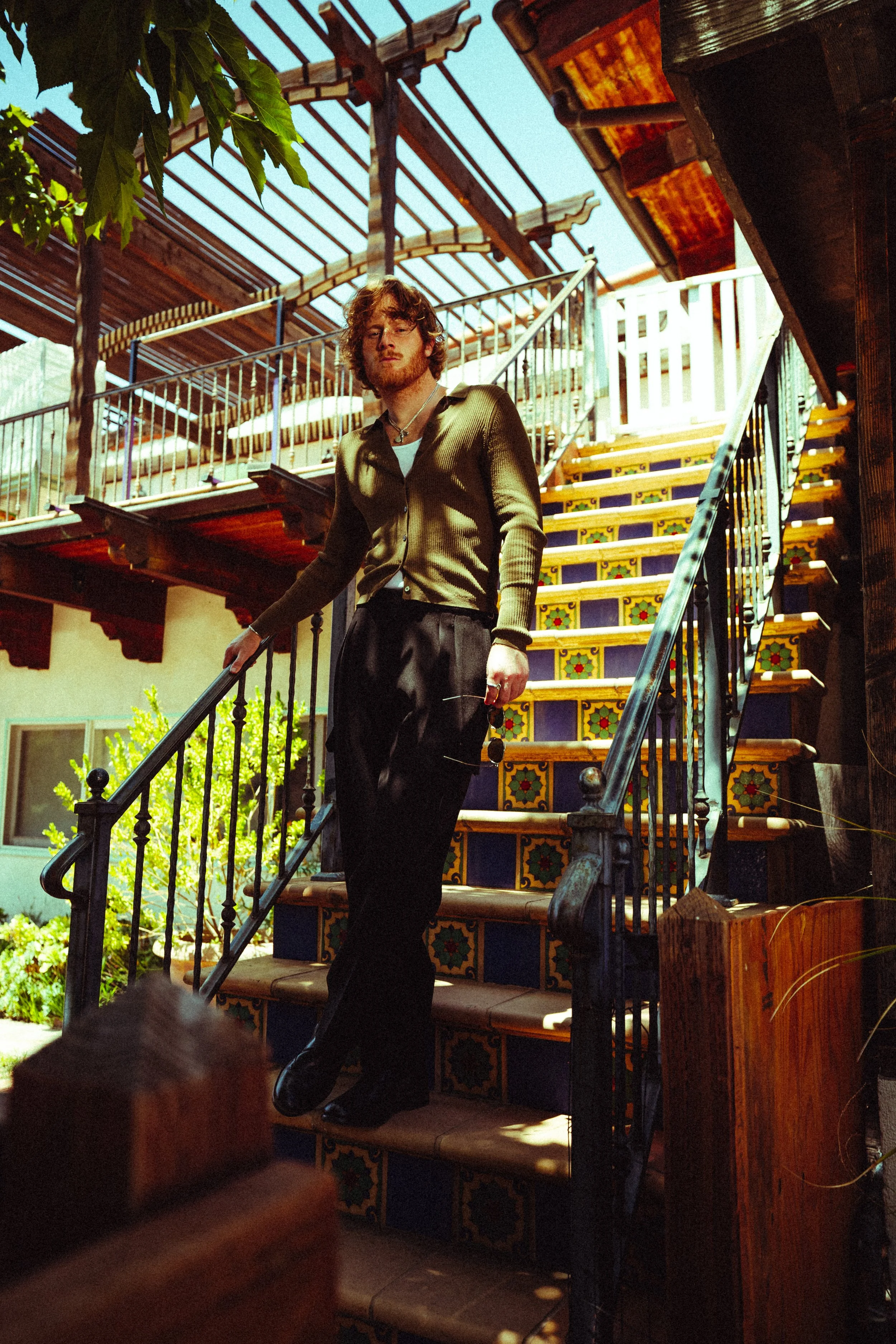
One recent song already feels particularly significant. Written during a writing camp, Hansen describes it as almost a follow-up to Yellowstone, although he isn’t ready to reveal its name. He says he “genuinely… haven't felt this way about a song in a very long time” and immediately wanted to play it live. For now, though, he has to wait. The song feels like “a secret that I'm holding,” he says, adding that he needs to “get it off my chest.” For an artist whose career was built partly on the immediacy of social media, learning when not to release something may be another sign of how much his approach has changed.
For all the evolution that can be found within Hansen’s sound, one belief remains constant: the music itself has to come first. “You have to make things that you love,” he argues that a song doesn’t need to be complicated to be meaningful. If an artist can write something “simple” and relatable that still “has deep meaning and cuts deep to people,” then sometimes “less words is better.” That philosophy feels particularly potent for an artist who built his career in an environment dominated by algorithms, trends and constant pressure to create content. Hansen has benefited enormously from social media, but he refuses to mistake attention for substance. “At the end of the day, like the song is still king,” he says. “You know, music wins every time.”
There is something always so captivating about someone that truly loves that they do. An underrated virtue is the devotion, dedication and passion a person has for their work. Rather than music being simply a job, an interest in the ever-so elusive music industry, or a hobby, it is his craft. “I love making music. It's like my favorite thing to do in the world.” For Hansen, the enjoyment seems to come from the act of creating itself—not just from performing or releasing a finished song, but from being in the process of making something. It’s a sentiment that gives a glimpse into the enthusiasm behind his work and why creating remains such an important part of his life.
Now, as Hansen prepares to take Orchid around the world and eventually introduce listeners to a new body of work, he seems to have arrived at the same conclusion he started with: make something you believe in, and then let the audience decide what it becomes. “Whether it goes viral or not is up to the gods,” he states. “We'll see what happens there.”
MATT HANSEN UNVEILS ORCHID (DELUXE)
FEATURING TWO NEW TRACKS “UNFORGETTABLE” & “CANARY”
THE ORCHID TOUR KICKS OFF NEXT MONTH- SET TO REACH 37 CITIES ACROSS THE GLOBE

Following the breakout success of his Top 10 debut album Orchid, independent singer/songwriter Matt Hansen is opening his next chapter with Orchid (Deluxe). The expanded edition features three new tracks, “UNFORGETTABLE,” “Canary,” and recent single “UNSPOKEN,” giving fans a deeper look into the world Matt created with the original album while pushing the story forward into a new, more hopeful chapter.
Upon its release earlier this summer, Orchid debuted at #6 on Spotify’s Top Albums Debut USA chart, pushing his catalog beyond 1 billion streams worldwide. Standout tracks including “LET EM GO,” “something to remember,” and “yellowstone (holding you)” continue to rack up nearly half a million streams per day, while the album also marked Matt’s national television debut on The TODAY Show.
With Orchid (Deluxe) now out, Matt is bringing the album to fans around the world on The Orchid Tour. The 35-date run hits the UK and Europe next month, with the North American leg kicking off November 11 in Quebec City before making stops in New York City, Nashville, Los Angeles, and more. Full tour dates are available here and below.
