
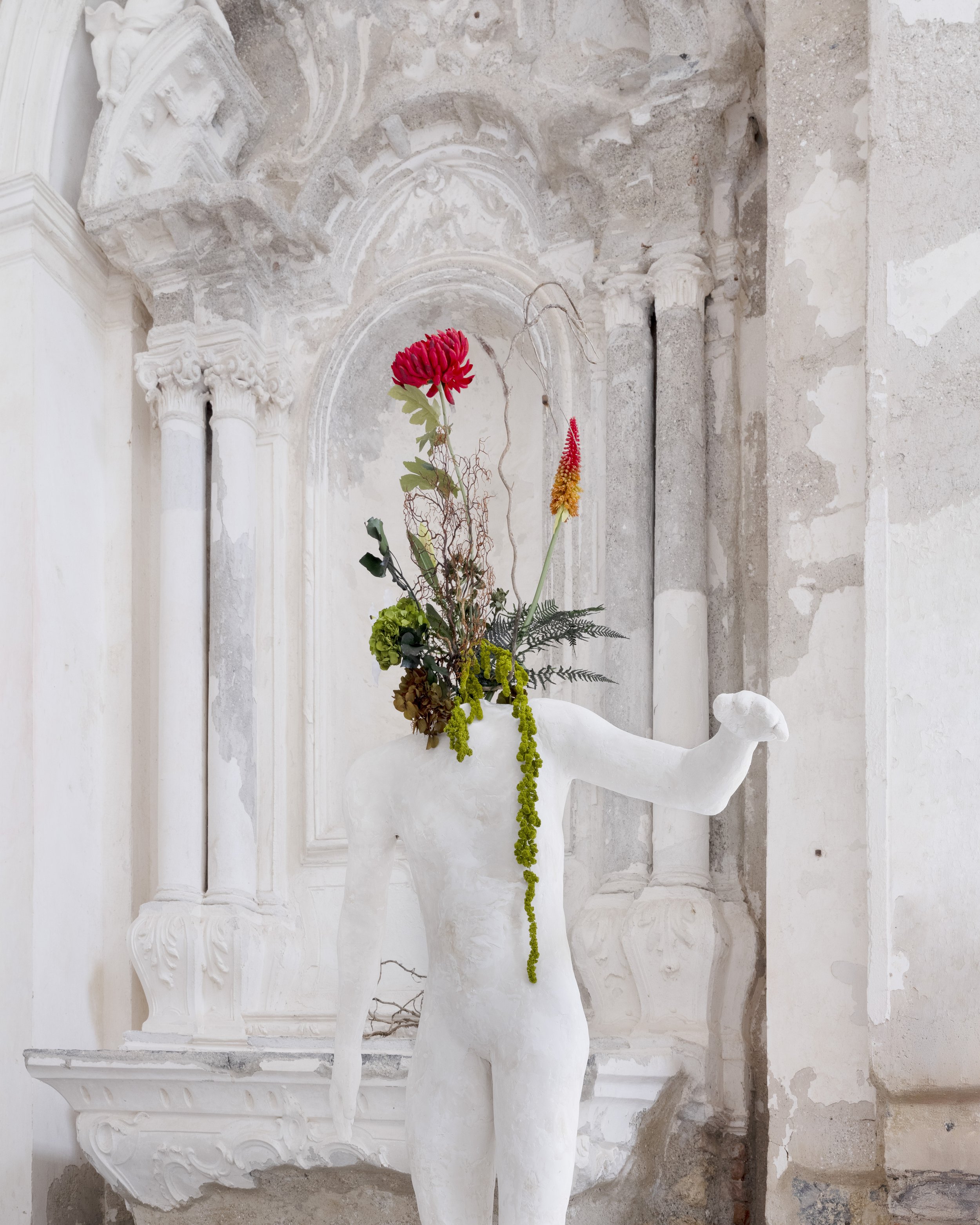
The Natural Bloom of Bergamo’s Orobie Biennial
Review by: Anya Duncan
As the year draws to a close and Italy’s art world pauses to consider which moments have truly taken root in the mind of 2025, one weekend in Bergamo lingers with unusual clarity. It felt less like an event that arrived and departed, and more like something grown slowly from the clay and limestone of the region itself. Here, art took on the qualities of vegetation. Human-made, yes, but also deeply entangled with formations shaped over centuries of geological and cultural time.
The occasion was a widespread cultural programme launched by GAMeC – Galleria d’Arte Moderna e Contemporanea di Bergamo. Recently renamed The Orobie Biennial, the project has been unfolding since 2024 and will continue until the end of 2025, extending across the entire Province of Bergamo. From the pre-Alpine ridges that give the territory its “Orobic” name to the valleys, towns, urban parks and plains, this is an exhibition that resists enclosure. It does not sit neatly within walls, nor does it submit easily to a calendar.
Seen in retrospect, the weekend marked a quiet but significant shift in Italy’s contemporary art landscape. Not because it announced a spectacle, but because it proposed a different ecology for art to exist within. The Orobie Biennial is not an episodic, biennial bloom designed to draw visitors briefly into Bergamo’s orbit. It is an exhibition that unfolds for two years rather than every two years, saturating its surrounding terrain with culture and dialogue. Like a carefully tended ecosystem, it grows at a pace the land and the art world can sustain, asking what can endure beyond a single season of attention.

Agnese Galiotto, La montagna non esiste, 2025, Fresco Almenno San Bartolomeo (Bergamo), Courtesy GAMeC - Galleria d'Arte Moderna e Contemporanea di Bergamo, Photo: Nicola Gnesi Studio
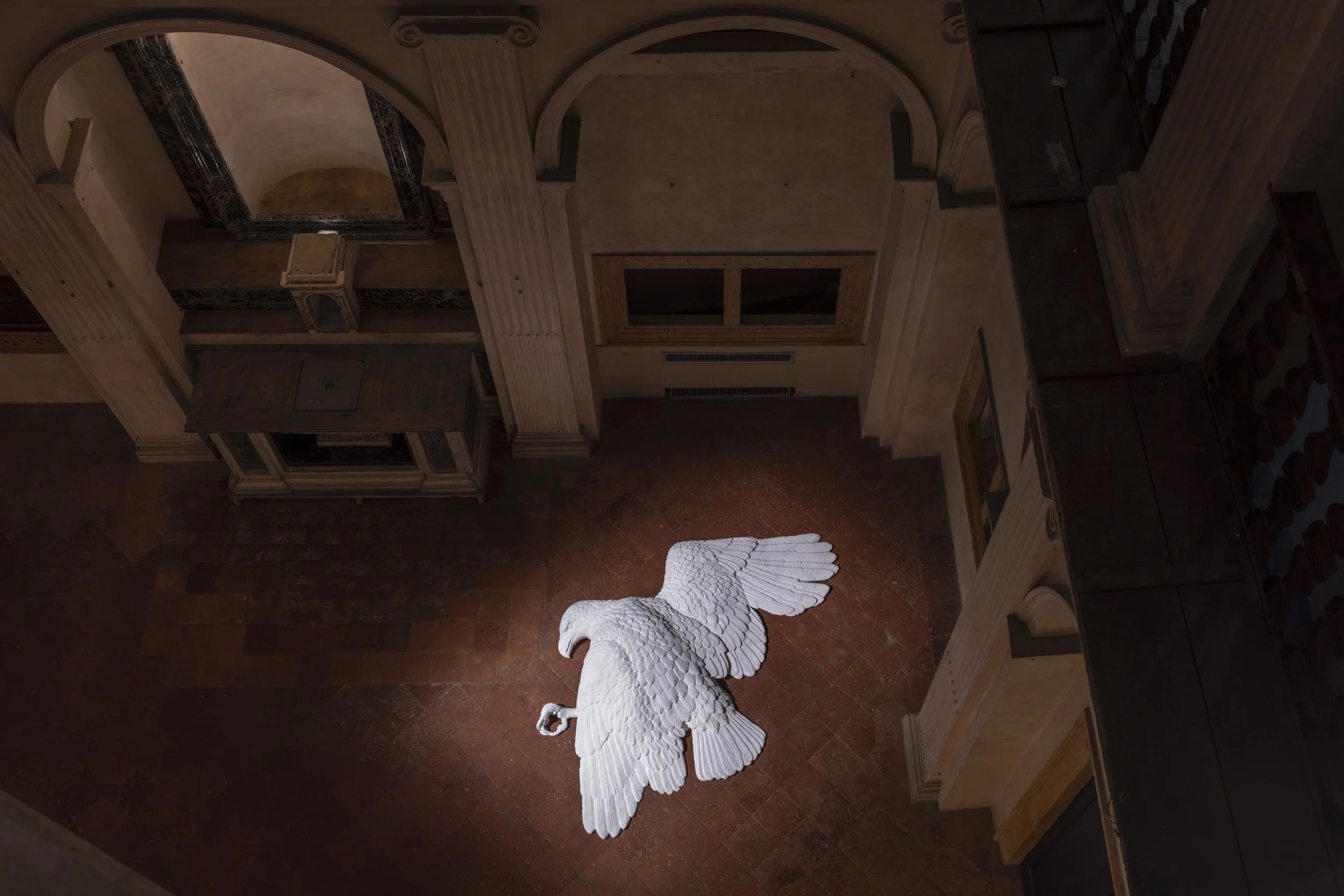
This sensibility was palpable throughout Bergamo. In the Upper Town, Palazzo dellaRagione once again served as GAMeC’s summer outpost, a role it has held since 2018. Within the vast Sala delle Capriate, Maurizio Cattelan presented a newly produced work alongside a constellation of sculptures — Bones, Empire, One and November — dispersed across the city. Together, they read like a meditation on cycles: growth and decay; ascent and collapse; margins and centres. Set against Bergamo’s layered history, the works carried an irony softened by sedimented time. It’s as if the art has been shaped by the same pressures that mould Bergamo’s surrounding hills.
Image Above: Maurizio Cattelan, Bones, 2025, Michelangelo statuary marble Courtesy Gagosian Gallery, Installation view – Ex Oratorio di San Lupo, Bergamo, 2025 Photo: Lorenzo Palmieri, Courtesy GAMeC - Galleria d'Arte Moderna e Contemporanea di Bergamo
Yet the project’s deepest roots extended beyond the city limits. In Villa d’Almè, Argentine artist Cecilia Bengolea presented a new work responding to the rhythms and social fabric of the area, continuing her exploration of movement, embodiment and collective experience. Further north, in Val Parina, art quite literally entered the landscape, rising like unexpected growths from the terrain through the interventions of German artist Julius von Bismarck and Bergamo-born Francesco Pedrini.
In Dossena (one of the oldest mining districts of the Brembana Valley) von Bismarck installed a site-specific work informed by centuries of extraction. Iron, fluorite, and the myths that tend to flourish wherever humans dig deeply defined the work. His intervention treated natural phenomena as active agents shaped by labour, belief and erosion. Stories here were shown to weather over time, stripped back until only their core remains. Nearby, in Roncobello, Pedrini adopted a different register. His contribution took the form of a permanent instrument for observing the celestial vault — a structure designed for longevity. Built to withstand time’s great flood, it invites return and pause.

Image above: Julius von Bismarck Landscape Painting (Mine), 2025 Installation view, Mines of Dossena Part of the GAMeC project "Thinking Like a Mountain - The Orobie Biennial" Photo: Nicola Gnesi Studio Courtesy GAMeC - Galleria d'Arte Moderna e Contemporanea di Bergamo

These mountain municipalities also hosted works by Francesco Ferrero, Gianmarco Cugusi and Roberto Picchi, reinforcing the sense that this was not a single exhibition scattered across sites, but a constellation of gestures embedded in lived environments. Art here did not overwrite the territory; it sprouted from it, drawing nourishment from local histories and conditions.
Looking back now, what feels most distinctive about that weekend in Bergamo is its unhurried quality. The experience resisted summary. The Orobie Biennial asks for revisiting. For seasons to pass. For weather and time to act as collaborators. It treats duration as a value and locality as a form of strength. And there is more to come. A new chapter of the project will open in June, and beyond that lies the anticipated opening of the new GAMeC building in 2026 — an institutional home that will inevitably be shaped by these years of working outward, into the territory that frames Bergamo’s borders. As Italy’s art scene reflects on another dense calendar of fairs, biennials and fleeting spectacles, Bergamo offers a different image to carry forward into the year’s end. Art that behaves like a plant burrowing into the mountain. Steadfast. Patient. Attentive to deep time. Art that endures.